
 Buy Tickets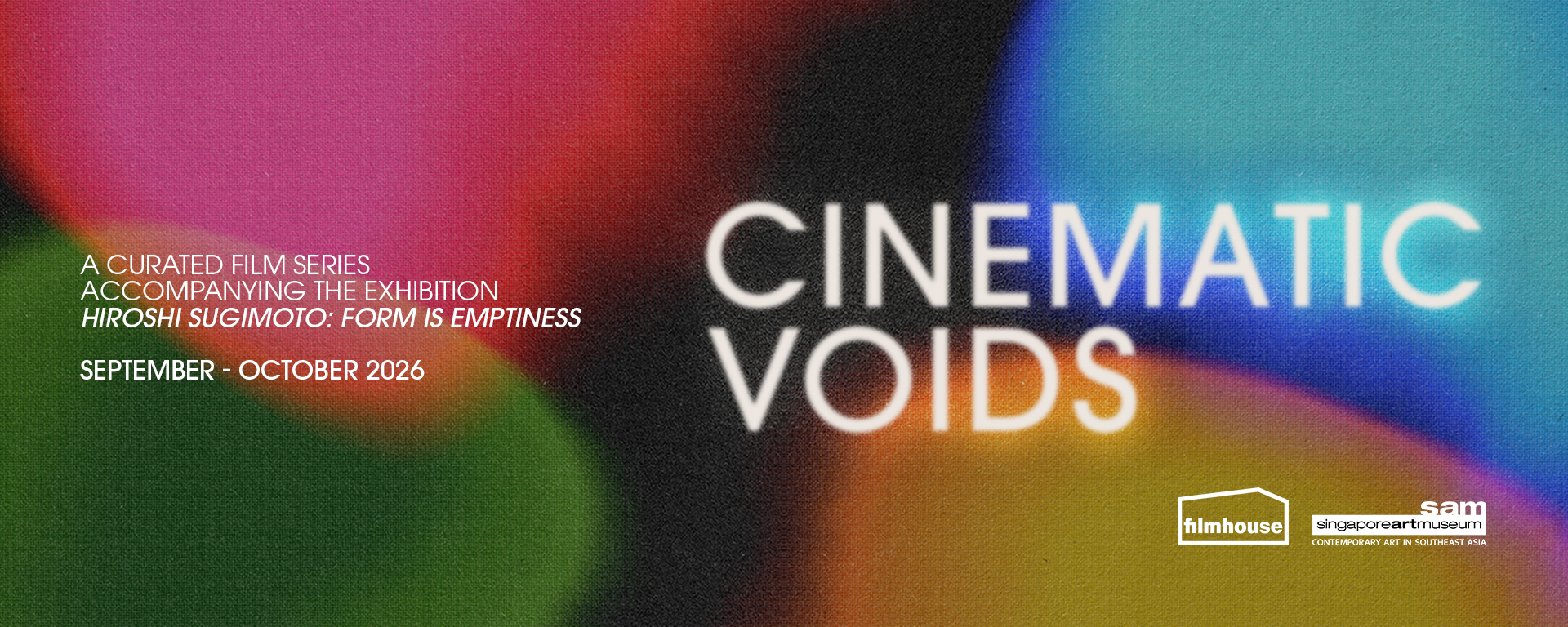
Cinematic Voids
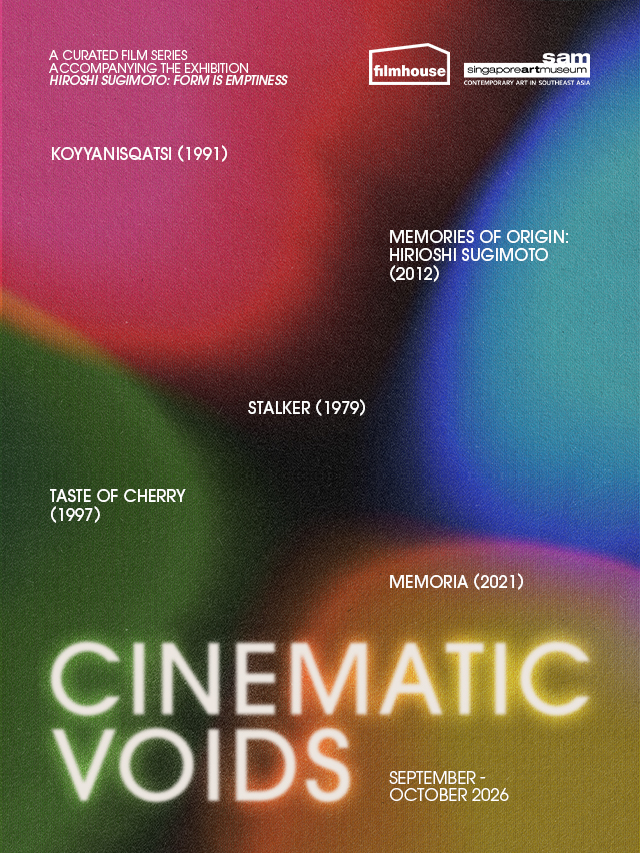
In collaboration with Filmhouse at Golden Mile Tower, we are pleased to present Cinematic Voids, a curated film series presented alongside the exhibition Hiroshi Sugimoto: Form Is Emptiness. Taking its cue from the exhibition's focus on the five elements, the programme explores the concept of the "Void" — a space that, in Sugimoto's world, is never truly empty, but rather brimming with potential, time, and light. The series serves as a moving-image extension of Sugimoto's meditative practice, inviting viewers to find depth in stillness and the unseen.
The five films trace this idea across each element in turn. In WATER, Sugimoto's own contemplations surface in Memories of Origin. EARTH is confronted head-on in the dust and barrenness of Taste of Cherry. FIRE burns through the mesmerising, haunting Koyaanisqatsi. WIND carries the sensory drift of Memoria. And finally, VOID opens into Stalker, where the world falls away entirely.
Water | Memories of Origin (2011, dir. Yuko Nakamura)
A deep dive into Hiroshi Sugimoto's own artistic philosophy, tracing the fluid nature of memory, origins, and the passage of time.
Earth | Taste of Cherry (1987, dir. Abbas Kiarostami)
A minimalist journey through a barren, dusty landscape, confronting the physical weight of the earth and the textures of life and mortality.
Fire | Koyaanisqatsi (1982, dir. Godfrey Reggio)
A kinetic, non-narrative collision of industrial energy, technology, and modern life accelerating out of balance.
Wind | Memoria (2021, dir. Apichatpong Weerasethakul)
An immersive sonic and visual journey where memories drift like invisible currents across shifting landscapes.
Void | Stalker (1979, dir. Andrei Tarkovsky)
A meditative journey into "The Zone" — the ultimate cinematic void, where time bends and the deepest corners of human desire are laid bare.
You won't master the elements in an afternoon. But sit in the dark with us, and you might just learn to see the way Hiroshi Sugimoto does.
films
Click on the '+' below to find out more!
Memories of Origin: Hiroshi Sugimoto by Yuko Nakamura

はじまりの記憶』(Memories of Origin: Hiroshi Sugimoto) by Yuko Nakamura
Japan | In Japanese with English Subtitles | 2011 | 83 min | PG
Weekdays: Standard $13 | Concession (Students & Seniors) $11
Weekends: Standard $16.50 | Concession (Students & Seniors) $14.50
Synopsis:
Directed by Yuko Nakamura, Memories of Origin: Hiroshi Sugimoto is an intimate documentary following 200 days in the life of the world-renowned contemporary artist. Pushing the boundaries of photography to position it as a conceptual medium, Sugimoto serves as a pivotal figure in modern art.
The film journeys alongside Sugimoto across key international sites—from capturing his Architecture series in Southern France and constructing a monumental installation for the 17th Biennale of Sydney, to creating Mathematical Surfaces in Provence and working on his Lighting Fields series in his New York studio. It also highlights his direction and production of traditional Japanese performing arts, asking what his practice reveals about life in contemporary times.
Expanded from an International Emmy-nominated television broadcast, this Director's Cut offers a deep reflection on memory, time, and artistic creation.
Taste of Cherry by Abbas Kiarostami

Taste of Cherry by Abbas Kiarostami
Iran | Persian, with English subtitles | 1997 | 99 min | PG13 (Some Mature Content)
Weekdays: Standard $13 | Concession (Students & Seniors) $11
Weekends: Standard $16.50 | Concession (Students & Seniors) $14.50
Synopsis:
Directed by Abbas Kiarostami, Taste of Cherry is an emotionally complex, minimalist meditation on life, death, and human connection. The film follows Mr Badii (Homayoun Ershadi), a middle-aged man driving through the dusty, hilly outskirts of Tehran in search of someone to perform a dark and delicate task: to bury him after he commits suicide, or to pull him out of the hole if he survives.
As he drives, Badii picks up three different passengers—a young soldier, a seminarian, and a museum taxidermist—whose conversations elicit contrasting perspectives on mortality, nature, and individual choice. Winner of the Palme d’Or at the 1997 Cannes Film Festival, Taste of Cherry offers a profoundly compassionate and open-ended exploration of the human condition.
Koyaanisqatsi by Godfrey Reggio

Koyaanisqatsi by Godfrey Reggio
United States | 1982 | 86 min | PG
Weekdays: Standard $13 | Concession (Students & Seniors) $11
Weekends: Standard $16.50 | Concession (Students & Seniors) $14.50
Synopsis:
Directed by Godfrey Reggio, Koyaanisqatsi is a landmark non-verbal cinematic experience that relies entirely on striking imagery and Philip Glass’s hypnotic, minimalist score. Utilising dramatic time-lapse and slow-motion photography, the film contrasts the majestic, deliberate beauty of natural landscapes in the American Southwest with the chaotic, relentless pulse of modern urban life.
The narrative progresses from pristine natural environments to the complex machinery of human civilisation—sprawling traffic networks, power grids, industrial plants, and urban decay—reflecting on the profound ecological and social imbalances wrought by technology. Free from dialogue or voiceover, Koyaanisqatsi invites viewers to bring their own interpretations to its mesmerising commentary on contemporary existence. It serves as the first movement in Reggio’s celebrated "Qatsi" trilogy, preceding Powaqqatsi (1988) and Naqoyqatsi (2002).
Memoria by Apichatpong Weerasethakul

Memoria by Apichatpong Weerasethakul
Colombia/Thailand/France/Germany/Mexico/Qatar/UK/China/ Switzerland | In Spanish & English | 2021 | 136 min | PG
Weekdays: Standard $13 | Concession (Students & Seniors) $11
Weekends: Standard $16.50 | Concession (Students & Seniors) $14.50
Synopsis:
Directed by Apichatpong Weerasethakul, Memoria is a hypnotic, slow-cinema mystery starring Tilda Swinton as Jessica, a Scottish botanist in Colombia who begins hearing a mysterious, resonant bang that only she can perceive. Haunted by this recurring sound, she embarks on an auditory journey from the bustling streets of Bogotá into the depths of the surrounding jungle to uncover its origin.
Shot on location in Colombia, this multi-lingual, deeply sensory film explores the fluid intersections of sound, memory, time, and human consciousness. Weaving together science, myth, and personal experience, Memoria offers a contemplative immersion into space and perception, distinguished by its unique commitment to the theatrical experience and its lingering, ethereal atmosphere.
Stalker by Andrei Tarkovsky

Stalker by Andrei Tarkovsky
Soviet Union | In Russian with English subtitles | 1979 | 161 min | PG
Weekdays: Standard $13 | Concession (Students & Seniors) $11
Weekends: Standard $16.50 | Concession (Students & Seniors) $14.50
Synopsis:
Directed by Andrei Tarkovsky, Stalker is one of the most immersive and rarefied experiences in the history of cinema, embarking on a metaphysical journey through an enigmatic post-apocalyptic landscape. A hired guide—the "Stalker" of the title—leads a writer and a scientist into the heart of the Zone, a restricted site of a long-ago disaster, where the three men search for the Room, a place rumoured to fulfil one’s most deeply held desires.
Adapting the science-fiction novel Roadside Picnic by Arkady and Boris Strugatsky for what would be his final Soviet feature, Tarkovsky created a challenging and visually stunning work defined by painstaking attention to material detail and a rich, organic atmosphere. At once a religious allegory, a reflection of contemporary political anxieties, and a meditation on film itself, Stalker envelops the viewer while opening up a multitude of possible meanings.