Various locations in Central Business District (CBD)
Free
Momentary Pulses:
Art in the Central Business District
Responding to the shifting rhythms of Singapore’s Central Business District (CBD), Momentary Pulses invites Singapore-based artists to create works that slip into the space between buildings and pedestrian paths, offering moments for listening and reminiscence. These quiet interventions fold into the rhythms of daily routines, drawing attention to the subtle irregularities of urban time and textures that surface when we pause.
The CBD in Singapore has undergone several key phases of development since pre-independence days. Within this urban landscape, different moments in the city-state’s history sit side by side, visible in the material traces that remain. Civic buildings from the late 1950s and 1960s such as the Singapore Conference Hall and Trade Union House (now Singapore Conference Hall) and the first Singapore Polytechnic at Prince Edward Street (now Bestway Building) still stand, a witness to Singapore’s independence and burgeoning industralisation. The sprouting of high-rise buildings in the 1970s through 1980s changed the skyline and extended the footprint of the CBD to Tanjong Pagar through the establishment of government buildings such as the Ministry of National Development, Monetary Authority of Singapore, The Treasury and CPF Board.
As global expectations for an attractive business environment shift, recent rejuvenation plans have emphasised mixed-use development, with work-life integration and sustainability at their core. From being the first port of call for traders to a high-density commercial belt, the urban forms of the CBD today are the result of continual transformation. Each key phase of development reflects not only the island’s economic aspirations but also the changing profile and rhythms of its workforce.
It is this layering of forms and textures that Momentary Pulses is interested in The CBD’s shifting workspace trends continue to reshape how its spaces are used and felt. The movement of bodies through the district reveals the embodied character of the place and its hidden memories.
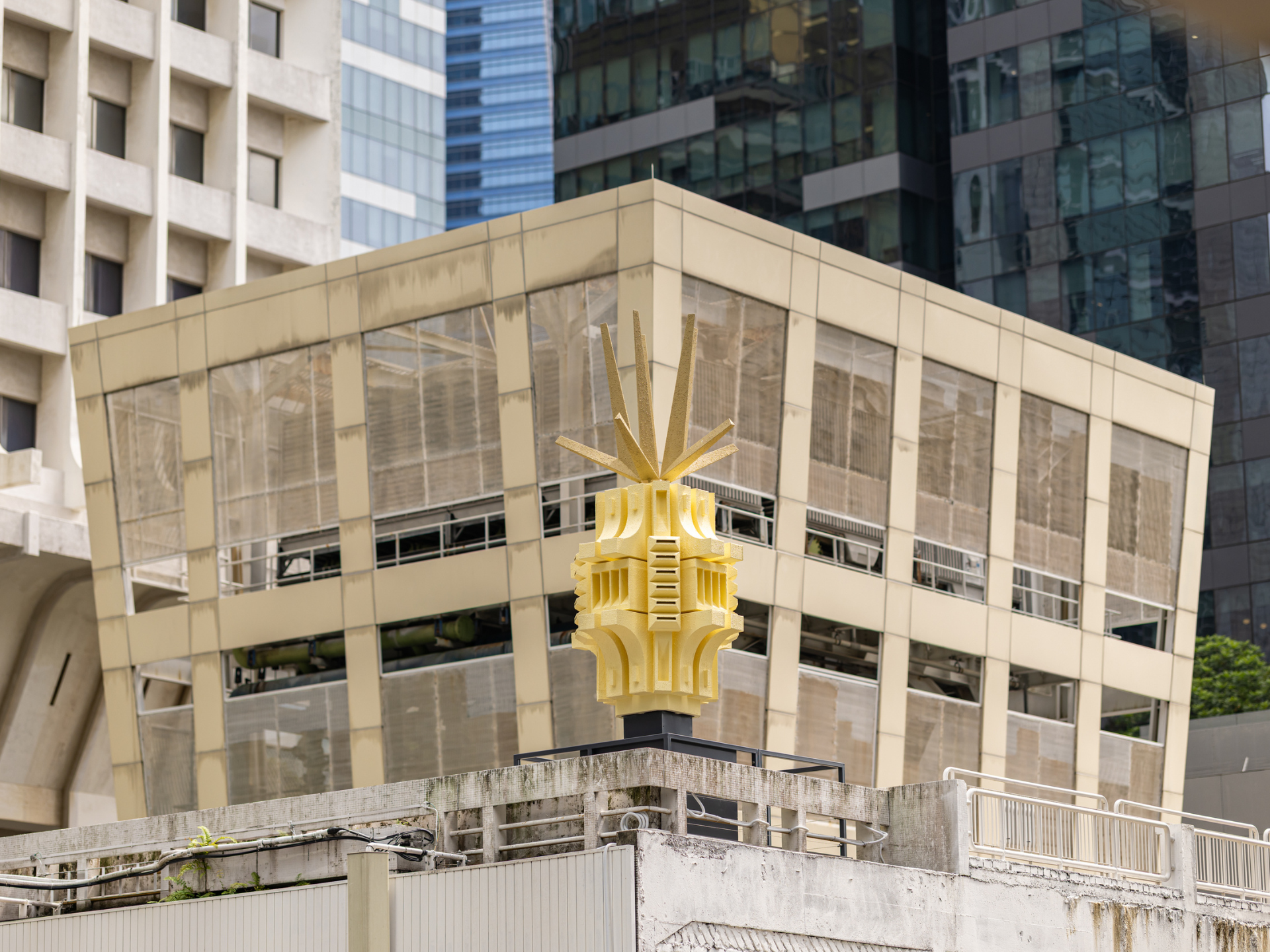
The earthy material of the ceramic tiles in Catherine Hu’s A fountain when it rains juxtaposes with the glass-and-steel building it fronts and mirrors the row of trees the sculptures face, insisting on the natural amidst the built. Sweet Water by Finbarr Fallon acknowledges an architectural style which, in its time, denotes a certain modernity. Yet, the references to street vending and cultural symbolism instil in architecture a social memory.
If a city embodies life, it is manifested in Teow Yue Han’s and Federico Ruberto’s creation of thusspoke.baby, a digital entity that develops a personality as it draws from daily information exchange, absorbing and projecting the city’s consciousness. This encounter with a digital other invites an awareness of our self as absorbed by and immersed in the daily workings of a business district. Likewise, Immanuel Koh’s Neural Panoptic Black is an invitation to keenly observe the urban landscape and respond through the active agency of looking and imbuing the material city with our human intentions.
It is in this landscape that we navigate, alongside thousands of users of the district through new buildings and streets standing in place of the old, along link bridges of all shapes and design and across reclaimed lands extending paths and roads in often bizarre ways. We might ask: what sort of rhythms exist in a business district where time is of the essence and moving through it demands quick decision and deft navigation? The two works, LOOP – The Resonance of Motion by Zul Mahmod and Clock of the Everyday by Yang Jie, offer different interpretations of CBD’s pulses: the former a score synchronised with its daily movements; the latter a keeper of time out of sync with everyday habits.
While we explore the CBD as a site of constant change and adaptation, Song-Ming Ang’s Still Afloat speculates on the development of a future landscape. We ask: what holds a business district?
Momentary Pulses: Art in the Central Business District
Momentary Pulses: Art in the Central Business District
Momentary Pulses: Art in the Central Business District
Momentary Pulses: Art in the Central Business District
Momentary Pulses: Art in the Central Business District
1 of 5
Teow Yue Han & Federico Rubertothusspoke.baby
2026
Real-time generative video and text, transparent LED display
Location: OUE Link
--------------------
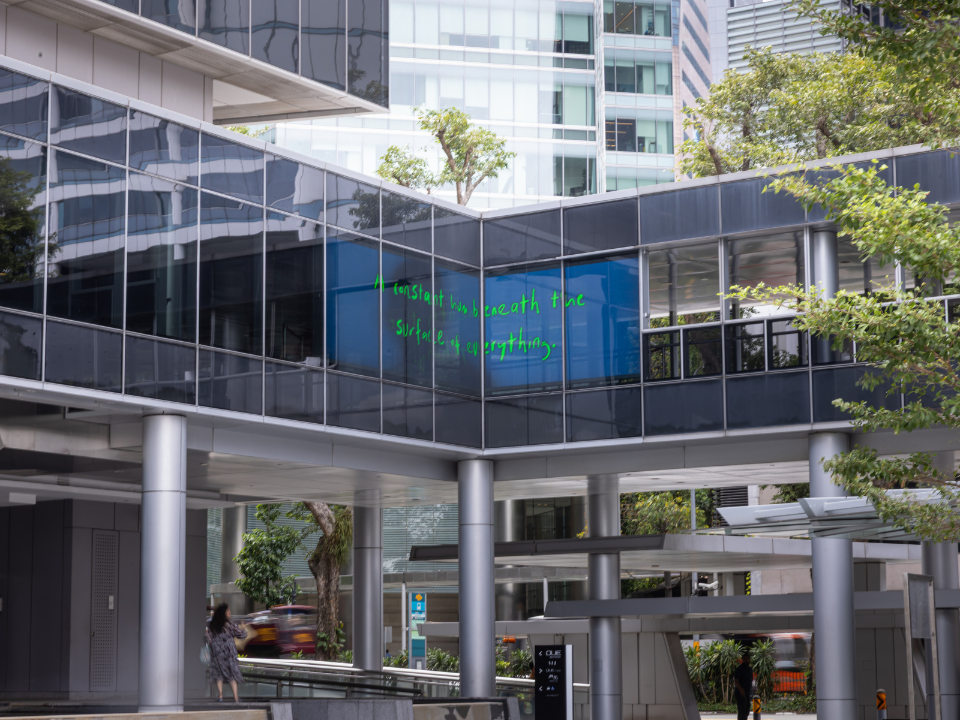
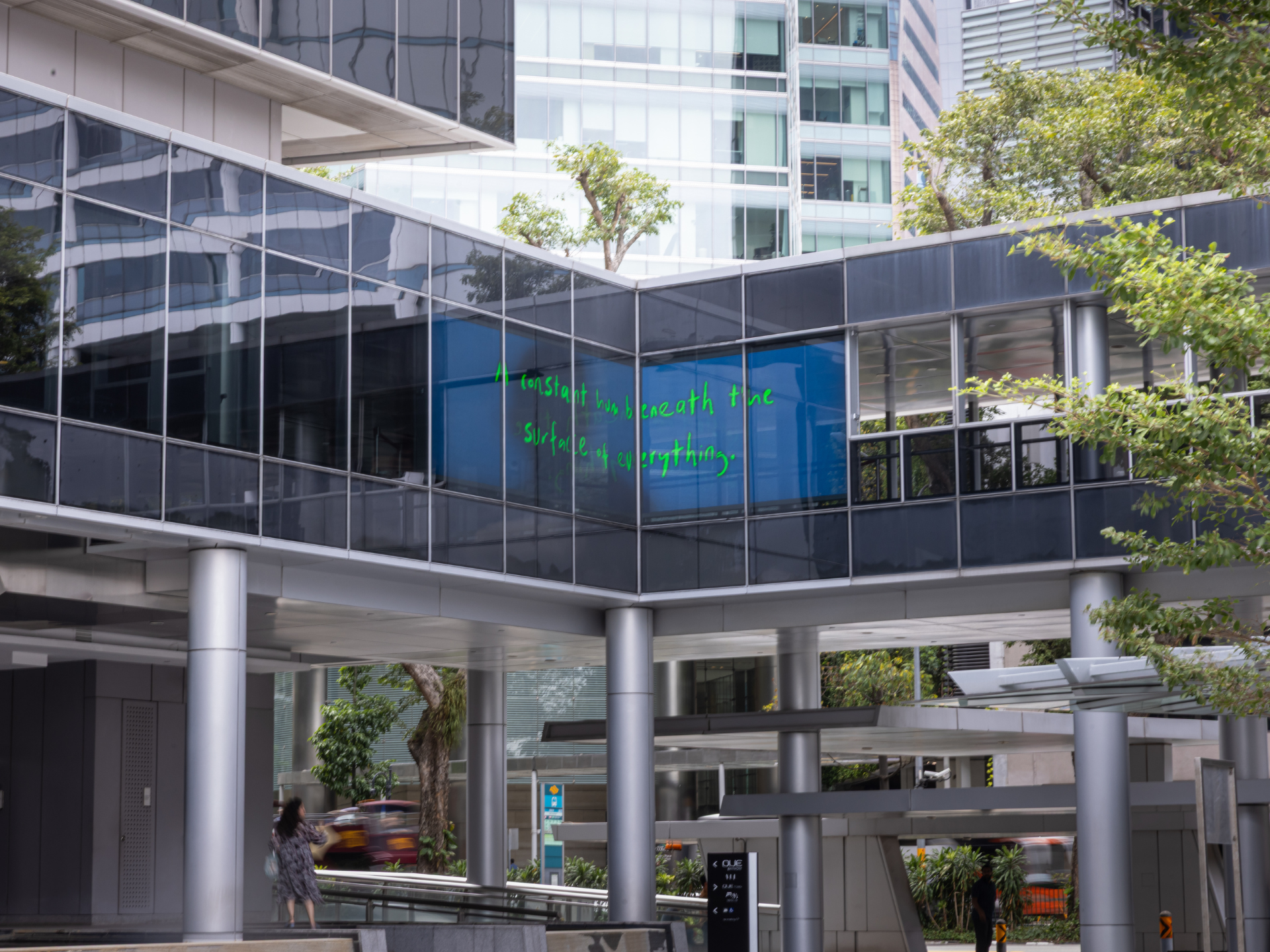
thusspoke.baby is conceived as a living entity that resides in the space of the digital. Evolving over time, the virtual character learns and grows as it receives a constant stream of information and influences from the digital world. Throughout the day, it responds to real-time data such as news, weather and even social media content from around the world, through projecting fragments of text and performing polymorphous gestures. This reflective and sometimes playful monologue accumulates into a digital body that grows in sophistication over time. The title references Friedrich Nietzsche’s Thus Spoke Zarathustra, reflecting on consciousness as a tool of the body and on speech in the age of Large Language Models. At the same time, “.baby” alludes to self-identity as a work-in-progress, particularly in the current digital age.
Catherine HuA fountain when it rains
2026
Salvaged ceramic tiles, concrete, fibreglass
Location: One Raffles Quay (North Tower)
--------------------
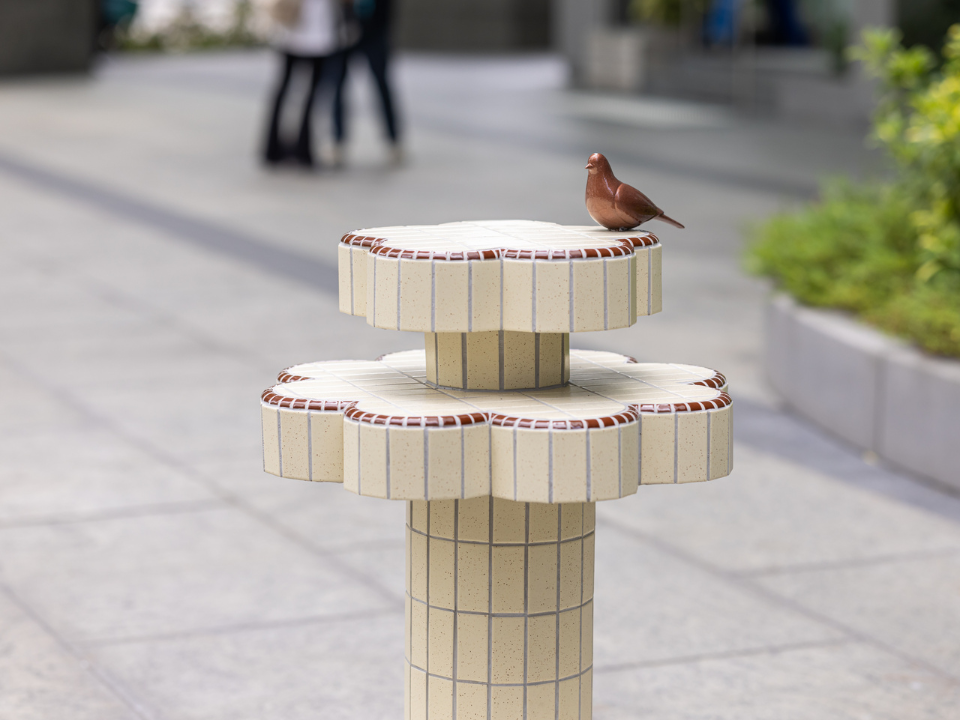
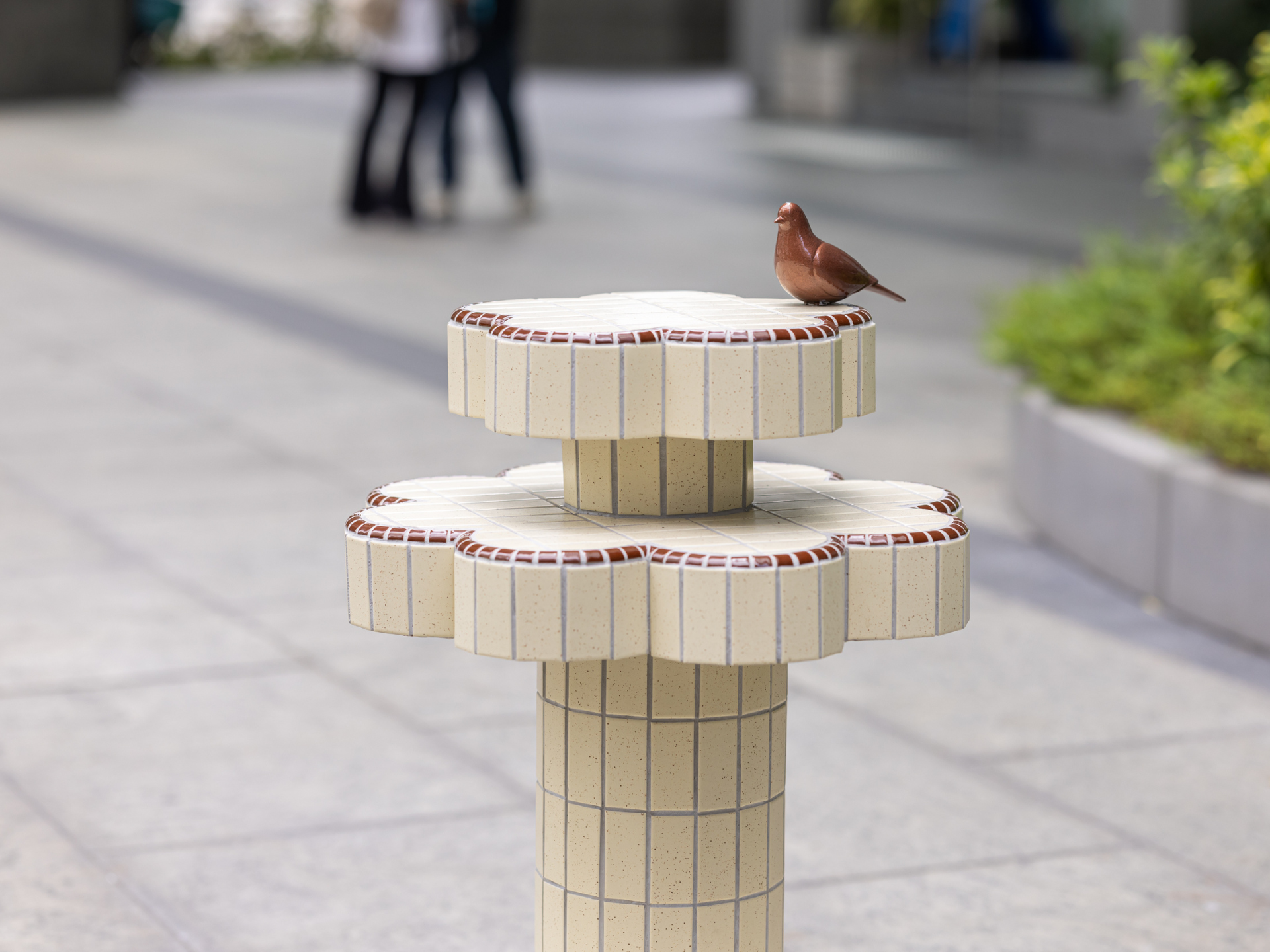
A fountain when it rains explores the ambiguous role of fountains in urban design as objects of utility and aesthetics. While modern fountains are often part of architectural designs, they quietly serve the functions of marking spaces of pause and gathering, masking noise or enhancing fengshui. In this work, Catherine engages with the notion of water features as denoting publicness and landscape: the former in its use of ceramic tiles that recall public furniture in HDB void decks; the latter through its adaptation of the formal appearance of garden bird baths. Nestled amidst towering glass and concrete buildings, subtle tension arises in the contrasting material textures, the natural and the built—little bird sculptures serve as sundials, futile in their attempt to tell time in the shadows of high-rise buildings, with the key element of water as an incidental occurrence, making the sculptures a fountain only when rain falls.
Finbarr FallonSweet Water
2025
Cast concrete and fibreglass
Location: Shenton House
--------------------
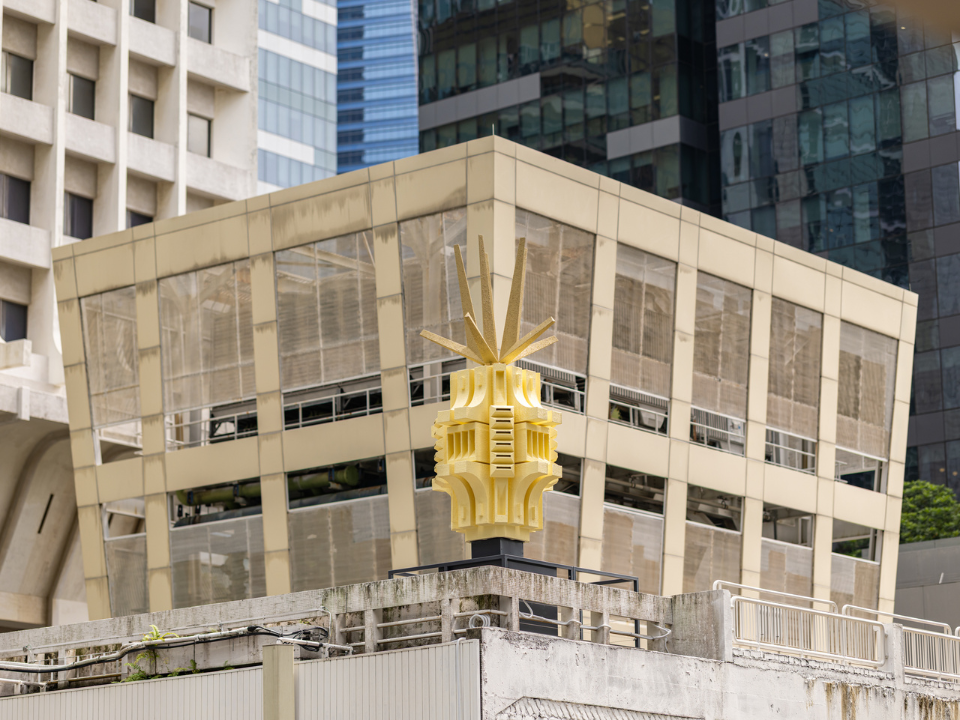
Situated at Shenton House—soon to be demolished and the last of Shenton Way’s “three sisters”—Sweet Water responds to its iconic brutalist design. The series of sculptures is inspired by the building’s grid-like form and mosaic crown, playfully translating them into a pineapple. Placed at the edge of the rooftop carpark and along street-level planters, their texture mimics the brutalist aesthetic, paying homage to an architectural style prevalent in Singapore in the 1970s and 1980s. The work is also a sculptural tribute to the pineapple, an enduring symbol of prosperity in Singapore. Pineapples in the CBD are not a new phenomenon: an 1861 record notes that slices of the fruit were sold at Raffles Place for one cent. Titled after a 1970s headline celebrating a surprising flow of fresh water during early Shenton Way redevelopment, Sweet Water celebrates the enduring symbols and the memory of an ever-changing cityscape.
Zul MahmodLOOP – The Resonance of Motion
2026
Stainless steel, clear acrylic tube, tweeters, metal, USB drives and audio amplifiers
Location: Asia Square (Tower 1)
--------------------
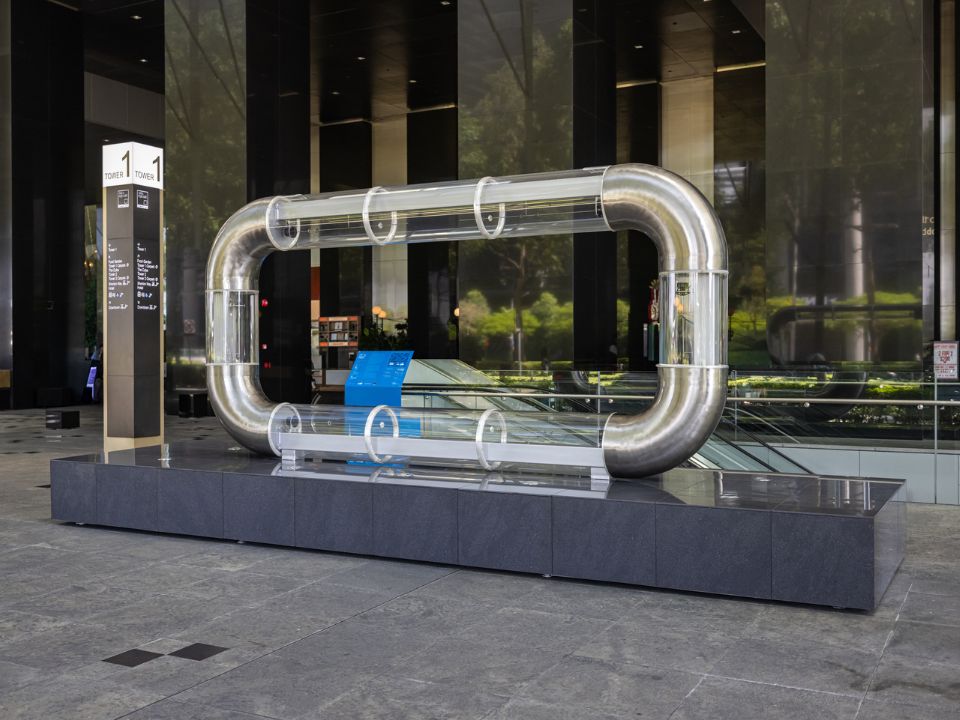
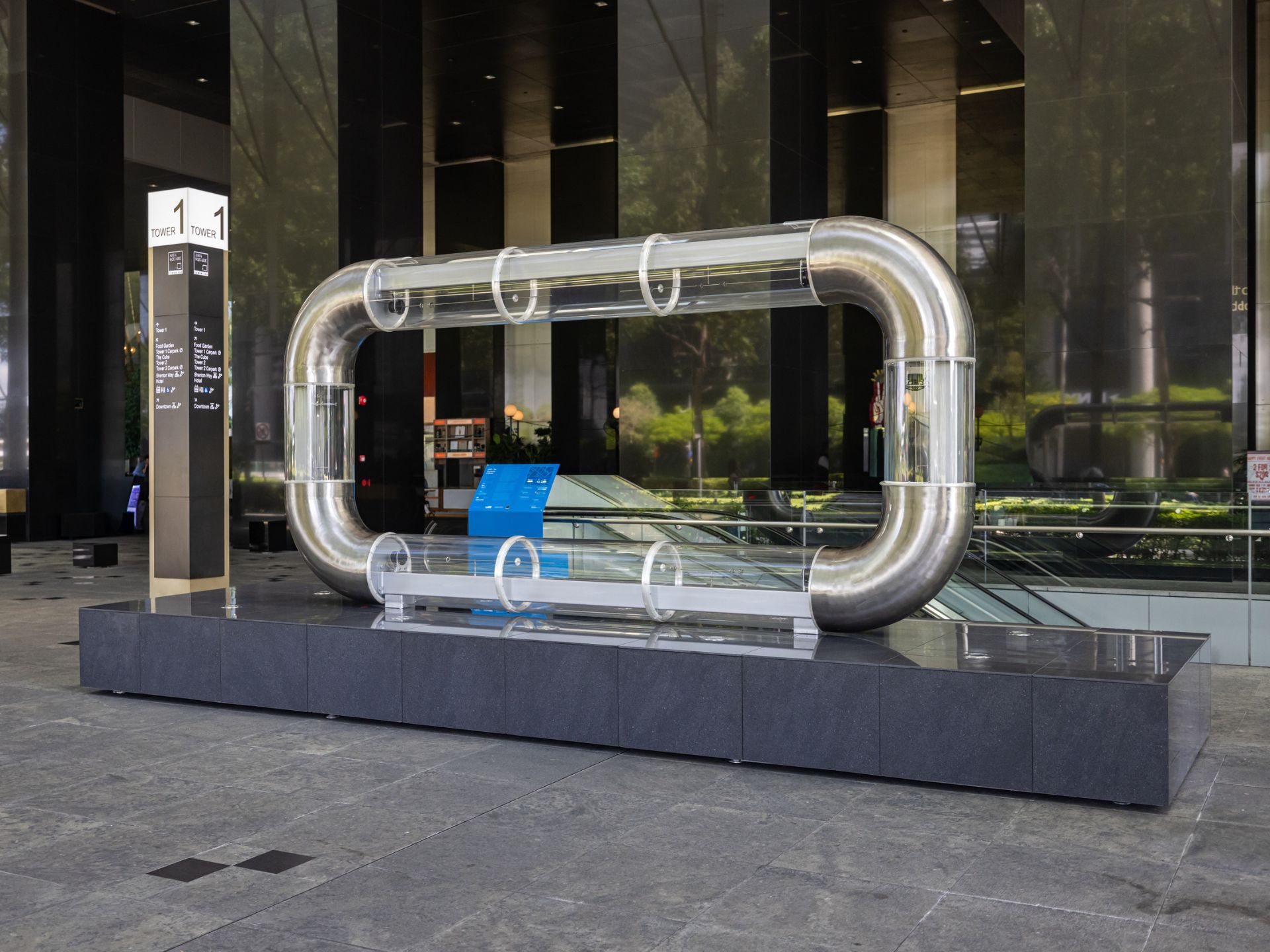
LOOP is a sound sculpture that transforms motion into resonance, capturing the cyclical rhythms of economy, architecture and urban life in the Central Business District. The polished stainless-steel sculpture reflects its environment, capturing the movement of light, passersby, and the ever-changing urban landscape. Activated by vibration, the work translates the flow and movement in the commercial zone into a sound composition, producing an unseen vibe and a texture for a transitory space that persists beyond a fleeting moment. As its material and sound both “feedback” on its surroundings, LOOP becomes a metaphor for the invisible forces—data flows, decisions, transactions—that drive the city. It is a temporal sculpture: constantly in flux, sonically alive and shaped by the unpredictability of motion—a sensory experience of the living systems we move through every day.
Yang JieClock of the Everyday
2026
Kinetic sculpture, found objects, motors, sound components
Location: Raffles Place MRT Exit E
--------------------
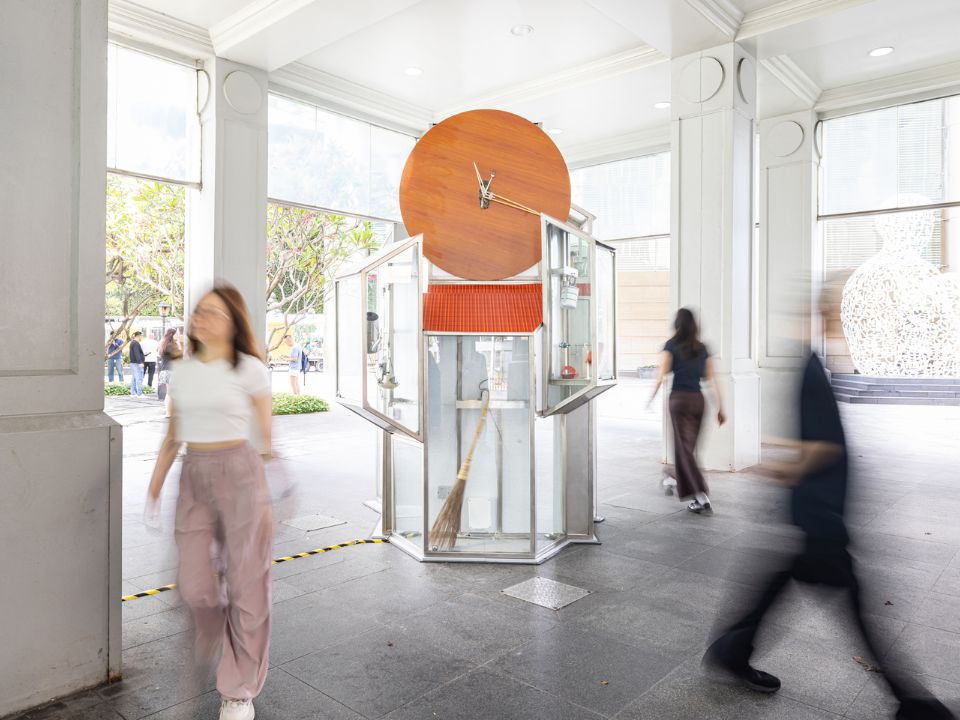
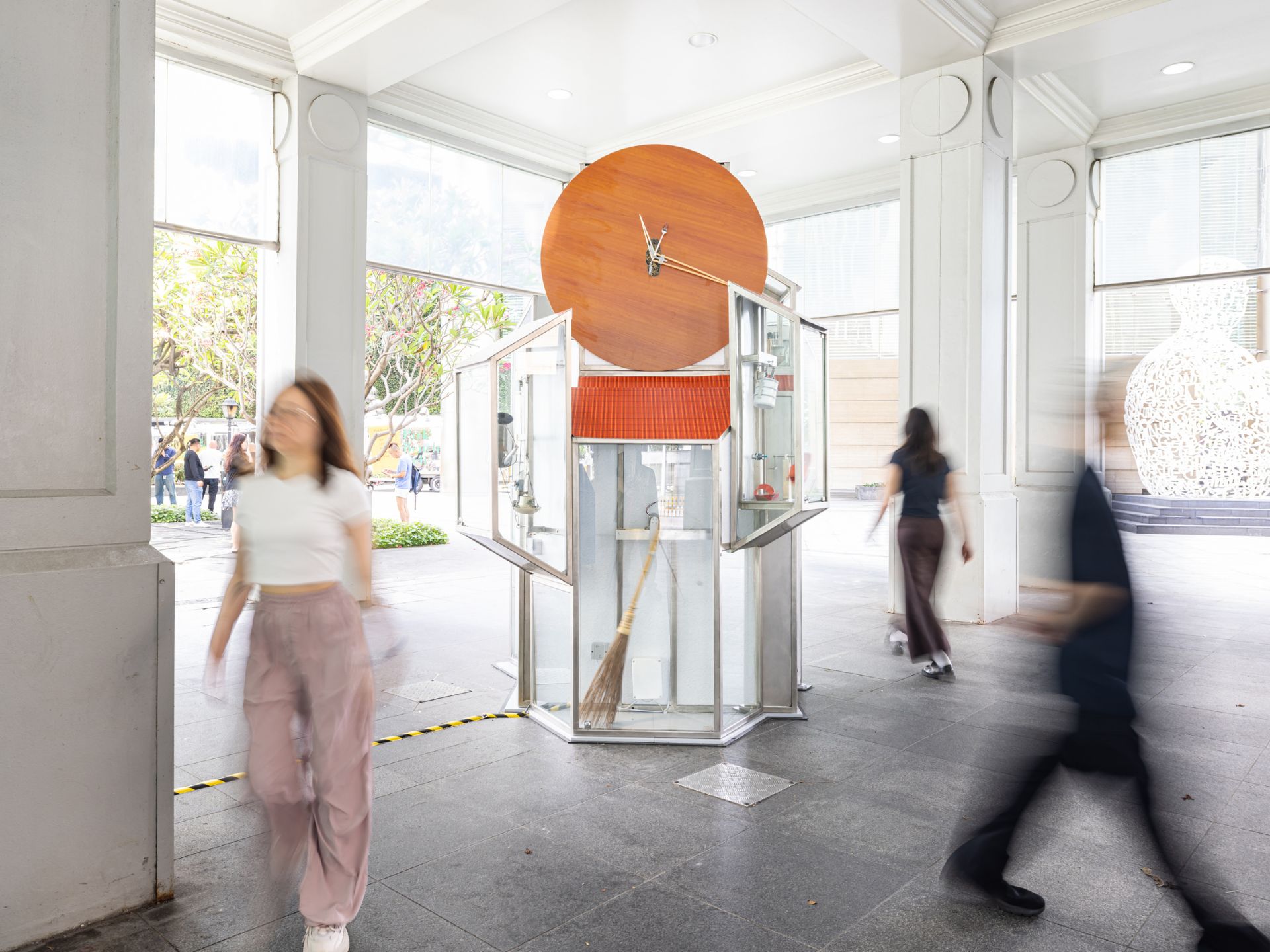
Clock of the Everyday is a kinetic sound sculpture that responds to the rhythms and memories of daily life in Singapore and inspired by mechanical clocktowers such as the Rathaus Glockenspiel, the Lau Pa Sat clocktower and the Seiko Floral Clock which was once a landmark at Raffles Place Park. Through sounds produced by found objects moving and acting on one another, the sculpture acts as a timekeeper of esoteric rhythms of daily life in the city. This orchestra of familiar items invites associations with everyday moments, from the quiet morning coffee to the clatter at lunch time to the chatter at tea breaks. Time here is told in the present but also alludes to the past as various vintage objects evoke nostalgia, traditions and memories. In the work, the regularity of workday patterns persists as a timed choreography of movements but is also playfully disrupted as they chime at moments slightly off the norm.

 Buy Tickets